If you’re running digital marketing campaigns, you’ve probably heard the term landing page countless times. But what exactly is a landing page, and why does it matter so much?
A landing page is not just another page on your website. It is a standalone page built with one specific objective: conversion. Whether that goal is capturing leads, driving sales, or promoting a single offer, landing pages are designed to remove distractions and guide visitors toward one clear action.
Many businesses send traffic to their homepage and wonder why conversions stay low. The issue usually isn’t traffic volume; it’s focus. Landing pages exist to solve that problem by aligning the message, the offer, and the call to action into one streamlined experience.
In this guide, I’ll explain what a landing page is, how it works, the different types you’ll encounter, and why it plays a critical role in modern marketing strategy.
What is a Landing Page?
A landing page is a standalone web page designed to drive one specific action, such as signing up, making a purchase, or downloading a resource.
Unlike regular website pages that encourage browsing, a landing page focuses on a single goal, often called a call to action (CTA). It is typically used in marketing campaigns and is where visitors “land” after clicking on an ad, email, or promotional link.
The purpose of a landing page is simple: remove distractions, align with the campaign message, and guide visitors toward conversion.
How a Landing Page Works?
A landing page works by connecting a traffic source to a specific conversion goal.
When someone clicks on a paid ad, email link, social media post, or search result, they are directed to a page built specifically for that message. Instead of offering multiple navigation options, the landing page presents one clear action, such as signing up, booking a demo, or making a purchase.
This alignment between the ad and the page is often called message match. When the headline, offer, and call to action reflect what the visitor expected to see, conversions increase.
In a marketing funnel, the landing page typically sits between awareness and action. It captures interest and turns it into measurable results.
Landing Page vs Homepage?
Although they may look similar, a landing page and a homepage serve very different purposes.
A homepage is the main entry point of a website. It provides navigation to multiple sections, introduces the brand, and supports broad exploration. Visitors can browse products, read blog posts, learn about the company, or navigate to different services.
A landing page, in contrast, is built for a single objective. It removes most navigation elements and focuses entirely on guiding visitors toward one specific action, such as signing up or making a purchase.
Here’s the core difference:
| Factor | Landing Page | Homepage |
| Goal | Drive one specific conversion | Introduce brand and support exploration |
| Navigation | Minimal or removed | Full navigation menu |
| Focus | Single offer or CTA | Multiple paths and objectives |
| Use Case | Marketing campaigns | General website traffic |
In simple terms:
Homepage = browsing
Landing page = action
If your goal is conversion from a specific campaign, a landing page is the better choice.
Key Elements of a High-Converting Landing Page
A high-converting landing page is carefully structured to guide visitors toward a single action. Every element on the page should reduce friction, build trust, and reinforce the value of the offer.
Here are the core components that consistently drive conversions:
1. A Clear, Benefit-Driven Headline
The headline is the first thing visitors see. It should immediately communicate what the user will gain, not just what the product is. Strong headlines are specific, relevant to the traffic source, and aligned with the visitor’s intent.
2. Supporting Subheadline
A subheadline expands on the main promise. It clarifies the offer, addresses a pain point, or adds context that strengthens the initial message. This section helps visitors quickly understand why the page matters to them.
3. A Focused Call to Action (CTA)
The CTA is the centerpiece of the landing page. It should be prominent, action-oriented, and easy to understand. High-converting pages avoid multiple competing CTAs and instead guide users toward one clear next step.
4. Persuasive and Concise Copy
Landing page copy should highlight benefits over features. It must answer key questions, reduce objections, and keep the reader moving toward action. Short paragraphs, bullet points, and clear language improve readability and engagement.
5. Relevant Visuals
Images or videos should reinforce the offer, not distract from it. Product previews, demonstrations, or contextual imagery can help visitors visualize the outcome of taking action.
6. Social Proof and Trust Signals
Testimonials, reviews, case studies, or recognizable brand logos increase credibility. Social proof reduces hesitation and reassures visitors that others have successfully taken the same step.
7. Minimal Navigation and Distractions
High-converting landing pages remove unnecessary menus and links. Limiting exit points keeps attention focused and increases the likelihood of conversion.
8. Fast, Mobile-Optimized Design
Page speed and responsiveness directly affect performance. A slow-loading or poorly optimized page can cause users to abandon before completing the action.
When these elements work together, the landing page creates a seamless path from interest to conversion.
Types of Landing Pages
Not all landing pages serve the same purpose. The structure and content vary depending on the campaign objective and where the visitor sits in the buying journey.
Here are the most common types of landing pages:
1. Lead Generation Landing Pages

Also known as lead capture pages, these are designed to collect user information through a form. In exchange, visitors typically receive something of value, such as an ebook, webinar registration, discount code, or free consultation.
These pages are common in B2B marketing, high-ticket services, and email list building strategies.
2. Click-Through Landing Pages

Click-through pages are used to warm up visitors before sending them to a checkout page or sign-up flow. Instead of collecting information immediately, they provide persuasive content that prepares users to take the next step.
These are often used in ecommerce and SaaS campaigns.
3. Sales Landing Pages
Sales landing pages focus directly on driving a purchase. They typically include detailed benefits, product features, testimonials, FAQs, and strong calls to action.
Unlike simple click-through pages, sales pages may be longer and designed to address objections before the user commits.
4. Event or Webinar Landing Pages
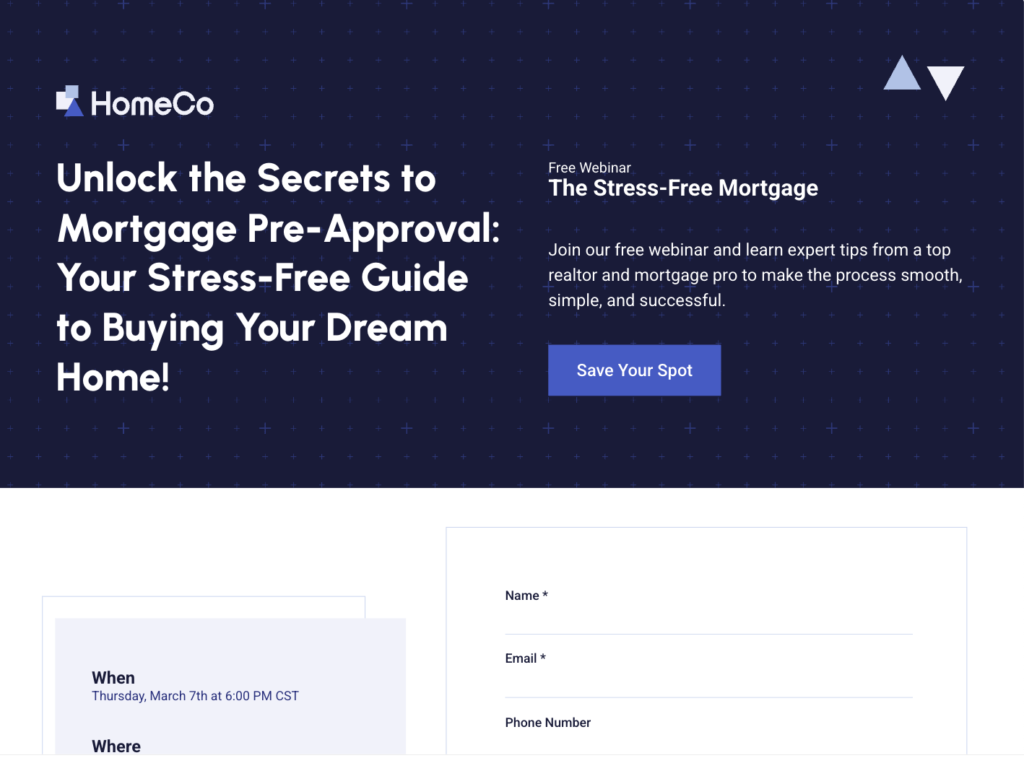
These pages are built specifically to promote an event, webinar, workshop, or virtual session. They highlight the date, agenda, speakers, and benefits, and typically include a registration form.
Their primary goal is sign-ups within a defined timeframe.
5. Squeeze Pages

Squeeze pages are highly minimal landing pages designed to capture email addresses quickly. They usually contain very little content, just a headline, short value statement, and a form.
They prioritize speed and simplicity over detailed persuasion.
Different goals require different landing page structures. Choosing the right type depends on whether your objective is lead generation, direct sales, event registration, or audience building.
Why Landing Pages Matter in Digital Marketing?
Landing pages play a critical role in turning traffic into measurable results. Without them, marketing campaigns often lose focus and waste potential conversions.
Here’s why they matter:
1. They Increase Conversion Rates
By removing distractions and focusing on one clear action, landing pages create a streamlined path to conversion. Fewer navigation options mean fewer opportunities for users to abandon the intended action.
2. They Improve Paid Advertising Performance
Platforms like Google Ads and Meta reward relevance. When your landing page closely matches your ad message, you improve quality scores, reduce cost per click, and increase return on ad spend.
3. They Strengthen Message Alignment
Landing pages allow you to tailor messaging for specific campaigns, audiences, or offers. This consistency between the traffic source and the page experience builds trust and improves engagement.
4. They Support Lead Generation
By gating valuable content behind forms, landing pages make it easier to capture contact information and nurture prospects through the funnel.
5. They Enable Testing and Optimization
Unlike core website pages, landing pages can be duplicated and tested easily. Marketers can experiment with headlines, offers, visuals, and CTAs to continuously improve performance.
In digital marketing, traffic alone doesn’t guarantee results. Landing pages provide the focused environment needed to convert attention into action.
How to Create a Landing Page?
Step 1: Choose One Goal (Only One)
Start by deciding the single action you want the visitor to take: download a guide, book a demo, sign up, or buy. If you try to combine goals (like “download + contact us + explore pricing”), the page loses focus and conversions drop.
A landing page works best when success is measurable and simple: one page, one outcome.
Step 2: Match the Page to the Traffic Source
Before writing anything, look at where visitors are coming from. If it’s a Google Ad or Meta Ad, the landing page must repeat the same promise and language that users clicked on. This is a message match.
If the ad says “Free SEO audit,” the headline should confirm “Get a Free SEO Audit”, not a generic brand intro. When the page feels consistent with the click, bounce rate drops and conversions improve.
Step 3: Write the Core Copy (Headline → Benefits → Proof)
Build your content in a conversion-friendly order:
- Headline: state the benefit clearly
- Benefits: explain what the visitor gets and why it matters
- Proof: reduce doubt using testimonials, results, logos, or guarantees
Keep copy tight, but not vague. Visitors should understand the offer in seconds and feel confident they’re in the right place.
Step 4: Design the Layout Around One CTA
Your CTA should be obvious and repeated naturally as the user scrolls (without changing the goal). Use one primary CTA style and one action. If you’re collecting leads, the form should be the center.
If you’re selling, the button should lead to checkout. The layout should guide attention toward that action, not toward menus, sidebars, or multiple buttons with different outcomes.
Step 5: Reduce Friction (Forms, Fields, and Distractions)
Every extra step lowers conversion. If the page uses a form, ask only what you truly need. For most lead gen pages, name + email is enough.
Remove header navigation, unrelated links, and anything that invites people to “browse.” If visitors want to explore, they’ll go to your website. The landing page should keep them moving forward.
Step 6: Add Trust Signals Where Users Hesitate
Visitors hesitate right before they convert. This is where trust signals matter. Add the proof closest to the CTA: a testimonial, rating, client logo strip, security badge, or a simple guarantee.
If your offer has risk (pricing, demo requests, time commitment), address it directly using FAQs or short reassurance lines like “No credit card required” or “Cancel anytime.”
Step 7: Publish, Track, and Improve
Once the page is live, don’t treat it as finished. Track conversion rate, scroll depth, bounce rate, and form drop-offs. Then test one change at a time, headline, CTA copy, form length, hero section, or proof placement. Landing pages improve through iteration, and small changes often create big lifts.
A landing page doesn’t need to be complex. It needs to be aligned, focused, and built around one action, then improved based on performance data.
How to Drive Traffic to a Landing Page?
A landing page only works if the right people reach it. Traffic volume alone doesn’t guarantee results, relevance and intent matter more.
Here are the most effective ways to drive traffic to a landing page:
1. Paid Search (Google Ads & Bing Ads)
Paid search is one of the fastest ways to send high-intent traffic to a landing page. When someone searches for a specific keyword, they are already expressing intent. By targeting those keywords and directing clicks to a highly relevant landing page, you increase the chances of conversion.
The key is alignment. Your ad copy, keyword, and landing page headline must reinforce the same message. Poor alignment lowers quality scores and increases cost per click.
Best for:
- Lead generation
- High-intent offers
- Service-based businesses
2. Paid Social Advertising
Platforms like Meta, LinkedIn, and Instagram allow you to target users based on interests, demographics, or behavior, even if they’re not actively searching yet.
Paid social works well when your offer is compelling and visually appealing. Since users aren’t always in buying mode, your landing page must clearly communicate value within seconds.
Best for:
- Brand awareness campaigns
- Free resources
- Webinar registrations
- Product launches
3. Email Marketing
Email campaigns are powerful because you’re reaching an audience that already knows your brand. Instead of sending subscribers to your homepage, direct them to a landing page tailored specifically to that email’s message.
This increases message consistency and improves click-to-conversion rates.
Best for:
- Promotions
- Product announcements
- Event registrations
- Upsells
4. Organic Search (SEO)
Landing pages can also rank organically if optimized correctly. By targeting a specific keyword and aligning content with search intent, you can attract consistent, long-term traffic.
Unlike paid ads, organic traffic compounds over time. However, ranking requires strong content, internal linking, and authority.
Best for:
- Niche offers
- Long-term campaigns
- Educational resources
5. Partnerships and Referrals
Traffic can also come from collaborations, affiliate marketing, guest posts, influencer mentions, or external referrals. When possible, create a landing page specifically tailored to that audience segment.
Personalized landing pages often convert better than sending referral traffic to a generic page.
Best for:
- Influencer campaigns
- B2B partnerships
- Affiliate marketing
Driving traffic to a landing page is not just about quantity. The more aligned your traffic source is with your offer, the higher your conversion rate will be.
Landing Page SEO: Can Landing Pages Rank on Google?
Yes, landing pages can rank on Google, but only under the right conditions.
By default, many landing pages are built for paid traffic. They’re short, focused, and sometimes intentionally hidden from search engines. Because of this, they often lack the depth and internal linking structure needed for strong organic rankings.
However, a landing page can rank if it meets core SEO requirements.
When a Landing Page Can Rank
A landing page has a higher chance of ranking when:
- It targets a specific, well-defined keyword
- The content matches search intent
- It provides enough depth to answer the user’s query
- It is internally linked from relevant pages
- It earns backlinks over time
For example, a landing page targeting “free SEO audit” could rank if it explains the offer clearly, includes relevant supporting content, and aligns with what users expect when searching that phrase.
Why Do Websites Usually Rank More Easily?
Websites typically perform better in SEO because they:
- Contain multiple pages targeting related keywords
- Build topical authority over time
- Accumulate backlinks across the domain
- Strengthen internal linking structure
Search engines tend to reward websites that demonstrate broader expertise around a topic, rather than isolated campaign pages.
When You Should Optimize a Landing Page for SEO
Optimize a landing page for SEO when:
- The offer aligns with a keyword people actively search for
- The page will remain live long-term
- You want both paid and organic traffic
If the landing page is for a short-term promotion or highly specific ad campaign, SEO may not be necessary.
Landing pages are built for conversion first. SEO should support that goal, not dilute it. When done strategically, a landing page can both rank and convert.
Final Thoughts: What Makes a Landing Page Effective?
A landing page is more than just a standalone web page. It’s a focused conversion tool designed to turn traffic into measurable action.
Unlike a homepage or general website page, a landing page removes distractions and aligns closely with a specific campaign goal. When built correctly, it improves conversion rates, strengthens message alignment, and increases marketing efficiency.
Whether you’re running paid ads, promoting an event, or generating leads, a well-structured landing page ensures your traffic has a clear next step.
At its core, a landing page succeeds when it is simple, relevant, and aligned with user intent.
Frequently Asked Questions?
1. What is the main purpose of a landing page?
The main purpose of a landing page is to drive one specific action, such as signing up, downloading a resource, booking a demo, or making a purchase. It removes distractions and focuses entirely on conversion.
2. How is a landing page different from a homepage?
A homepage supports browsing and navigation across a website, while a landing page is built for a single goal. Landing pages typically remove menus and extra links to keep visitors focused on one call to action.
3. Can a landing page exist without a website?
Yes. A landing page can be created and published independently of a full website. Many businesses use standalone landing pages for short-term campaigns or product testing.
4. How long should a landing page be?
A landing page should be only as long as necessary to persuade the visitor to take action. Some offers require short, simple pages, while higher-priced or complex offers may require longer, more detailed content.
5. Do landing pages improve conversion rates?
Yes. Because landing pages focus on a single objective and reduce distractions, they often convert better than sending traffic to a homepage or general website page.
6. Can a landing page rank on Google?
Yes, if it targets a specific keyword, matches search intent, and provides enough depth. However, many landing pages are built primarily for paid traffic rather than organic search.
7. How many landing pages should a business have?
The number depends on the number of campaigns, audience segments, and offers. Many businesses create separate landing pages for different campaigns to improve relevance and conversions.