That’s all the time your landing page headline has to stop a visitor mid-scroll, earn their attention, and convince them to keep reading. Three seconds before they’re gone, back to Google, on to a competitor, lost forever.
And yet most landing page headlines sound like they were written by a committee: vague, feature-heavy, and painfully forgettable. “Welcome to Our Platform.” “Solutions for Modern Businesses.” “We Help You Grow.” Nobody converts on headlines like that.
Here’s the truth: a single headline change can double your conversions without touching anything else on the page. No redesign. No new ad spend. Just the right words in the right order.
In this guide, you’ll get 7 proven landing page headline formulas, the ones professional copywriters actually use, complete with real examples you can dissect, steal, and adapt for your own pages today.
Let’s get into it.
Why Landing Page Headlines Make or Break Conversions
Research from Nielsen Norman Group shows visitors read only 20% of any webpage. They land, scan your headline, and decide in seconds whether to stay or leave. Nothing else on the page gets a chance if the headline doesn’t hold them.
That makes it the single highest-leverage element on your page, more than the button color, the hero image, or even the offer itself.
Most headlines fail for one reason: they’re written from the brand’s perspective instead of the visitor’s. They lead with what the company does rather than what the visitor gains.
A headline that converts does five things instantly, grabs attention, states the value, speaks to the right person, creates curiosity, and feels credible. Miss even one, and you’re losing conversions you’ll never know you lost.
Fix the headline first. Everything else follows.
The Anatomy of a High-Converting Landing Page Headline
Every great landing page headline has the same underlying structure, even when the words look completely different. Understanding that structure is what separates copywriters who guess from those who consistently convert.
Clarity beats cleverness. Every time.
Your visitor isn’t trying to decode a tagline. They’re asking one question the moment they land: “Is this for me?” A clever headline that makes them think twice has already lost. A clear headline that answers that question instantly wins.
The primary headline and subheadline work as a team.
The headline hooks. The subheadline closes. Your primary headline should be bold and outcome-focused, the subheadline is where you add context, specifics, or proof. Think of them as a one-two punch, not two separate elements.
Here’s the difference in practice:
Headline: Turn Website Visitors Into Paying Customers
Subheadline: A/B testing software that helps SaaS teams increase conversions without guessing.
The headline is magnetic. The subheadline makes it believable.
The sweet spot: 6–12 words for your primary headline. Long enough to communicate value, short enough to land in a single glance. Subheadlines can stretch to 20–25 words where needed.
Use the blur test before you publish.
Step back from your screen, squint until the text blurs, and ask: Can someone still understand what this page offers? If the headline disappears into the design or feels generic at a glance, rewrite it.
Great landing page headlines aren’t written. They’re engineered.
Know Your Audience Before You Write a Single Word
The biggest mistake isn’t bad writing, it’s writing before you understand who you’re writing for. No formula saves a headline aimed at the wrong person.
Mine their exact words. Dig through Amazon reviews, Reddit threads, G2, and customer surveys. The phrases your audience uses to describe their problem are your headline’s raw material. When your headline mirrors their language, it feels like a conversation, not a sales pitch.
Lead with one thing. Your audience has many pain points. Your headline can carry only one. Pick the single biggest outcome they’re willing to pay for and lead with that.
Match awareness to the message. A cold visitor needs a problem-focused headline. A warm visitor needs an outcome-focused one. Writing a product-heavy headline for cold traffic is one of the most expensive conversion mistakes you can make.
Know who you’re writing for first. The words follow naturally.
The 7 Landing Page Headline Formulas That Convert
Formula 1: The Direct Value Proposition
The most reliable headline formula in existence. No tricks, no curiosity gaps, just a crystal clear statement of what the visitor gets and why it matters.
Structure:
[Outcome] + [Who It’s For] + [Timeframe or Differentiator]
It works because it respects the visitor’s time. They don’t have to decode anything. The offer, the audience, and the benefit are all visible in one glance.
Best for: Solution-aware audiences, SaaS, lead gen, service businesses.
Examples:
How to Write Landing Page Headlines That Convert (7 Formulas)
"Accounting Software Built for Freelancers Who Hate Spreadsheets"
"Hire Vetted Developers in 48 Hours — No Recruitment Fees"
Notice what each one does: it names a desired outcome, speaks to a specific person, and neutralizes a common objection or pain, all in under 12 words.
The trap to avoid: being so direct that you sound generic. “Grow Your Business Faster” is a direct value proposition, it’s also forgettable. Specificity is what gives this formula its teeth. The more precisely you name the outcome and the audience, the harder the headline hits.
Formula 2: The How-To Headline
“How to” has been converting readers since the dawn of direct mail. It works because it makes an implicit promise, follow this, and you’ll know how to do something you currently don’t.
Structure:
How [Target Audience] [Achieves Desired Outcome] [Without Common Pain]
Best for: Courses, webinars, guides, content upgrades, coaching offers.
Examples:
"How Freelancers Double Their Rates Without Losing a Single Client"
"How Small Brands Get Big Press — Without a PR Agency"
"How We Grew to 100K Users Spending $0 on Ads"
The “without” element is optional but powerful. It directly dismantles the biggest objection standing between your visitor and the conversion, before they even think to raise it.
The trap to avoid: being too generic with the outcome. “How to Grow Your Business” tells the reader nothing. “How Shopify Store Owners Hit $10K Months Without Running a Single Ad” tells them everything. The more specific the outcome, the more the right person feels like this was written specifically for them.
Formula 3: The Numbered List / Specificity Formula
Numbers stop the eye. They signal structure, credibility, and a defined payoff, the reader knows exactly what they’re getting before they commit to reading further.
Structure:
[Number] [Ways/Steps/Secrets/Mistakes] to [Achieve Specific Outcome]
Best for: Blog-to-landing-page content, lead magnets, email opt-ins, webinars.
Examples:
"7 Landing Page Formulas That Grew Our Conversions by 214%"
"3 Pricing Mistakes Killing Your SaaS Signups — And How to Fix Them."
"5 Emails That Bring Back Abandoned Carts on Autopilot"
Why does specificity work so well? Because vague claims feel like marketing. Specific numbers feel like proof. “Grew conversions significantly” is forgettable. “Grew conversions by 214%” makes you stop and wonder how.
Odd numbers outperform even ones. Studies on list-based content consistently show that 3, 5, and 7 outperform 4, 6, and 8; they feel less manufactured, more credible.
The trap to avoid: using numbers just for the sake of it. The number needs to feel earned. If your content only supports four points, don’t stretch it to five. Readers notice when lists are padded, and it destroys trust fast.
Formula 4: The Question Headline
A well-placed question does something statements can’t, it pulls the reader into the headline mentally. The moment they answer it in their head, they’re already engaged.
Structure:
[Pain-Based or Aspirational Question, they’re already asking themselves]
Best for: Cold traffic, problem-aware audiences, retargeting campaigns, high-emotion niches.
Examples:
"Tired of Ads That Drain Your Budget With Nothing to Show?"
"What If Your Website Worked as Hard as You Do?"
"Still Managing Your Team on Spreadsheets?"
The best question headlines feel like the visitor is being read. They land because the visitor has already been asking themselves that exact question; you’re just the first brand that acknowledged it.
Use questions for pain, statements for gain. Question headlines work best when tapping into frustration or a problem. For desire and aspiration, a direct value proposition or transformation headline typically converts better.
The trap to avoid: questions that can be answered with “no.” “Want More Sales?” sounds rhetorical and lazy. “Still Losing Leads Because Your Follow-Up Is Inconsistent?” forces a self-reflective yes, and that’s where conversion begins.
Formula 5: The Bold Claim / Guarantee Headline
When you have strong proof, a bold claim headline is the most powerful tool in your arsenal. It leads with an extraordinary outcome and immediately backs it with a risk reversal, turning skepticism into curiosity.
Structure:
[Extreme Outcome Statement] + [Proof Element or Risk Reversal]
Best for: High-trust offers, brands with strong social proof, products with guarantees or track records.
Examples:
"The Only CRM That Pays for Itself in 30 Days — Or It's Free"
"We'll Get You 10 Qualified Leads in 14 Days — Guaranteed or You Don't Pay"
"Join 40,000 Founders Who Scaled Past $1M Using This Exact System"
The risk reversal is what separates a bold claim from an empty boast. Anyone can make a big promise. Backing it with a guarantee, a number, or a proof element signals that you actually believe what you’re saying, and that shifts the psychological burden from the visitor to you.
Social proof as a claim. Numbers like “40,000 founders” or “$2B in revenue generated” function as bold claims too. They don’t need a guarantee because the scale itself is the proof.
The trap to avoid: making claims you can’t substantiate. Overpromising destroys trust the moment visitors hit the fine print, or worse, after they buy. Bold only works when the rest of your page can back it up.
Formula 6: The “If–Then” Conditional Headline
No formula targets a specific visitor more precisely than If–Then. It works like a filter — qualifying the right reader in and letting everyone else scroll past. That’s not a weakness, it’s the point.
Structure:
If You [Specific Situation], Then [Specific Outcome]
Best for: Niche audiences, high-ticket offers, B2B landing pages, retargeting.
Examples:
"If You're Running Google Ads and Not Hitting 3x ROAS, Read This."
"If You've Tried Every Diet and Nothing Sticks — This Is Different"
"If Your SaaS Is Stuck Between $10K and $50K MRR, Here's Why."
Notice how each one speaks to a very specific person in a very specific situation. The visitor doesn’t feel marketed to; they feel found. That emotional recognition is what drives the click.
The more specific the “if,” the harder it hits. Broad conditions like “If you want more sales” could apply to anyone, which means they resonate with no one. Narrow it down to a situation your exact buyer is living right now, and the headline becomes impossible to ignore.
The trap to avoid: making the condition so narrow that you shrink your audience beyond what the page can convert. There’s a balance between laser-targeted and too niche; test both ends to find your sweet spot.
Formula 7: The Transformation Headline (Before → After)
Of all seven formulas, this one hits the deepest. It doesn’t just promise an outcome; it promises a new identity. Visitors don’t just want a result; they want to become a different version of themselves. This formula speaks directly to that.
Structure:
From [Current Painful State] to [Desired State] in [Timeframe]
Best for: Coaching, courses, fitness, finance, career, and any transformation-driven offer.
Examples:
"From Scattered Spreadsheets to a Fully Automated Business in 14 Days"
"From Invisible to Fully Booked — Without Spending a Cent on Ads"
"From First Draft to Published Author in 90 Days"
The before state should sting a little. If the visitor doesn’t wince at the “from”, it’s not specific enough. The after state should feel genuinely attainable, not a fantasy. And the timeframe makes the whole thing feel real and actionable rather than vague and aspirational.
You don’t always need the timeframe. Sometimes the contrast between before and after is so stark that it carries the headline alone. “From Burnout to Business Owner” needs no timeframe; the transformation speaks for itself.
The trap to avoid: making the after state sound too good to be true without any proof on the page to support it. This formula raises expectations higher than any other; your landing page content must deliver on what the headline promises, or conversions will drop at the bottom of the funnel.
Best Landing Page Headlines (Real-World Examples Analyzed)
Formulas are only useful when you see them working in the wild. Here are three startups that got their landing page headlines right, and why they worked.
1. Superhuman — “The Fastest Email Experience Ever Made”
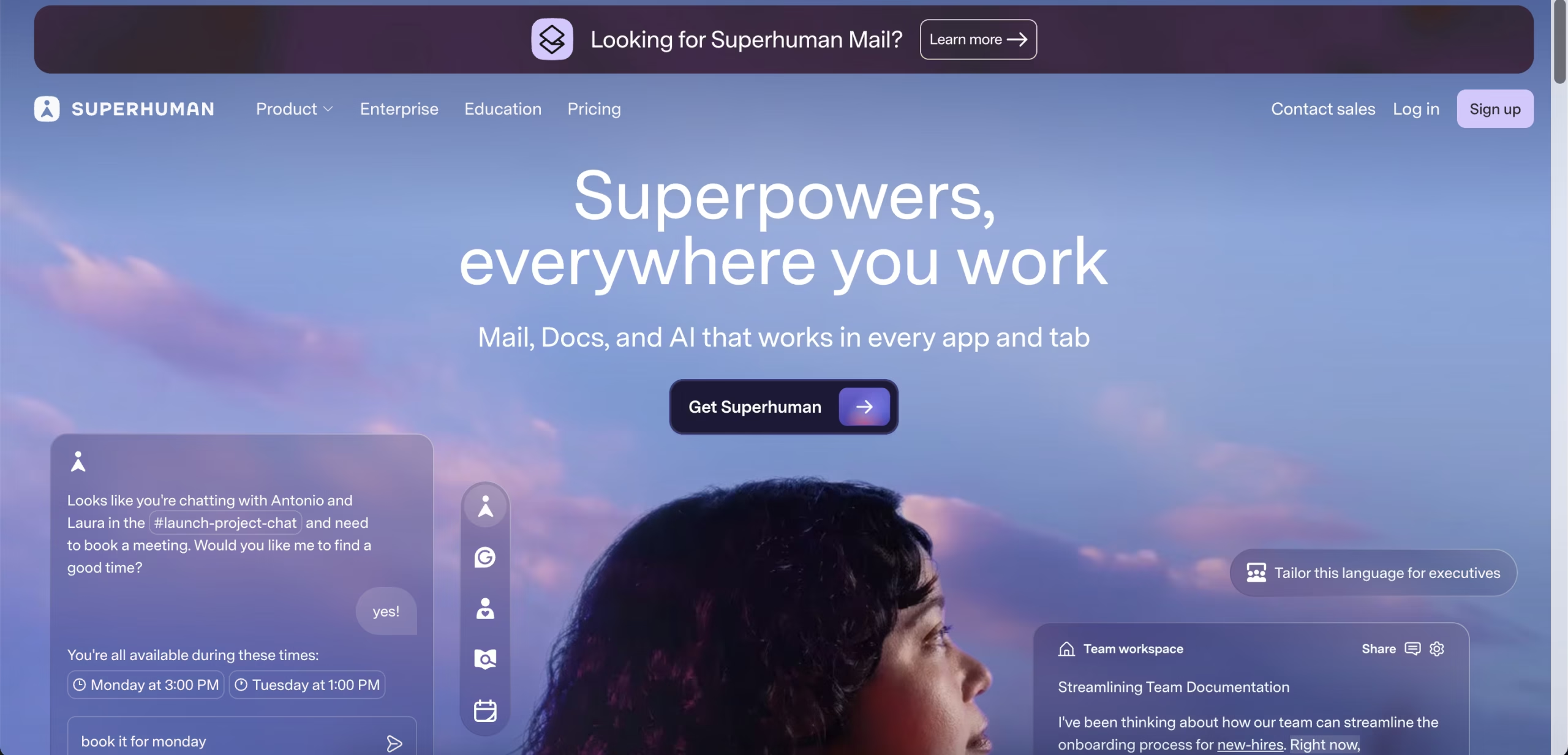
A direct value proposition that doubles as a bold claim. It doesn’t say “better email” or “smarter inbox”; it says fastest, which is specific, provable, and deeply tied to the pain of their target user: high-output professionals drowning in email. Six words. Zero ambiguity. The kind of headline that makes the right person think “finally.”
2. Loom — “Say It With Video”
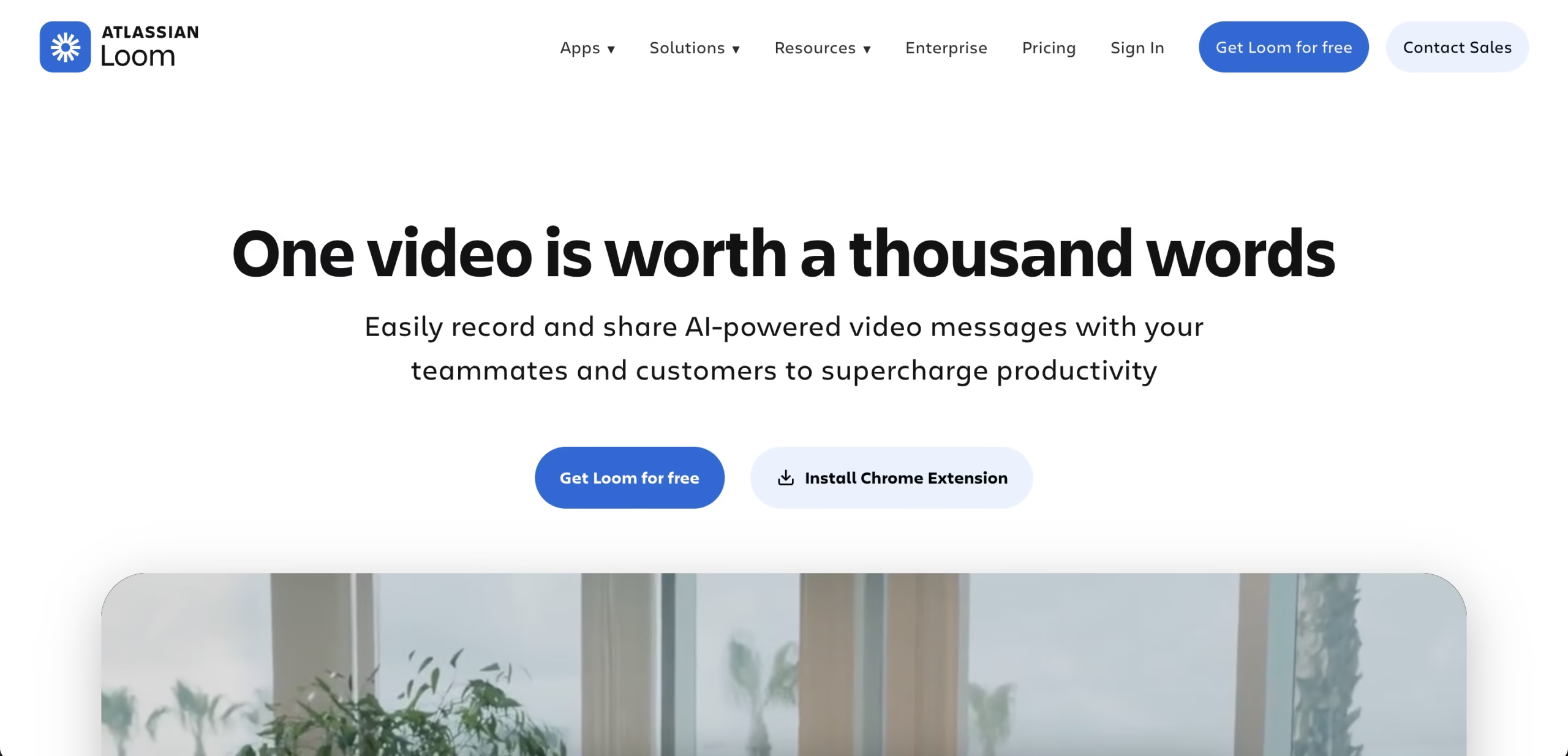
Deceptively simple transformation headline. The before state is implied: long emails, endless back-and-forth, miscommunication. The after state is three words. It worked because it didn’t over-explain a product people were unfamiliar with. It sold the behavior shift, not the software.
3. Beehiiv — “The Newsletter Platform Built for Growth”
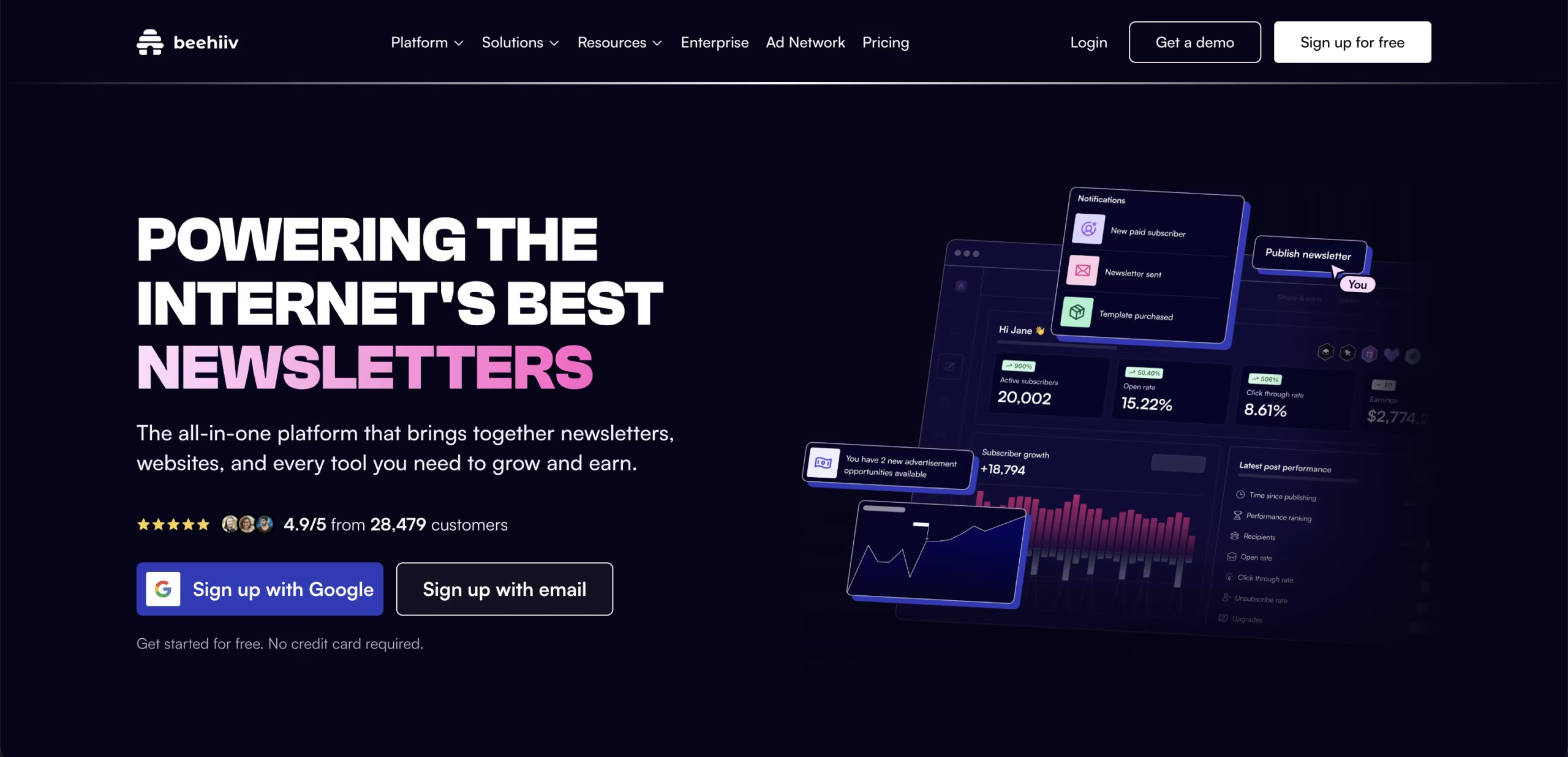
A direct value proposition with a sharp differentiator baked in. Every competitor says, “Send newsletters.” Beehiiv said built for growth, immediately signaling this isn’t just a sending tool, it’s an audience-building engine. One phrase repositioned the entire category for their audience.
Common Landing Page Headline Mistakes to Avoid
Getting the formula right is only half the job. These are the mistakes that quietly kill conversions even when the structure looks correct.
1. Writing for yourself, not your visitor.
Your headline should answer “what’s in it for me?”, not celebrate your product. The moment it starts with “We” or “Our,” you’ve already lost the plot.
2. Chasing clever over clear.
Wordplay feels creative in a brainstorm and falls flat on a landing page. If a visitor has to think twice about what you mean, they’re gone before they figure it out.
3. Mismatching your ad and your headline.
If your ad promises “Double your leads in 30 days” and your headline says “Welcome to Our Marketing Platform”, the visitor feels deceived. Message scent must run unbroken from the first touchpoint to the page. Breaks in scent are invisible conversion killers.
4. Being vague to appeal to everyone.
Headlines like “Solutions for Modern Teams” try to speak to everyone and end up resonating with no one. The narrower your headline, the stronger it lands with the right person.
4. Ignoring mobile.
A 14-word headline that looks sharp on desktop wraps awkwardly on a phone and loses all its punch. Always check how your headline renders on a small screen before publishing.
5. Never testing it.
Even the best copywriters don’t guess right every time. If you’re not A/B testing your headline, you’re leaving conversions on the table permanently.
How to A/B Test Your Landing Page Headlines Like a Pro
Writing a great headline is step one. Knowing which great headline wins is step two. Gut feeling gets you to good, testing gets you to great.
1. Always test the headline first
Before you touch button colors, images, or layout, test your headline. It has the highest impact on conversions of any single element on the page. Everything else is optimization. This is leverage.
2. One variable at a time
Test your headline against one alternative, not three. The moment you run multiple variants simultaneously without enough traffic, your data becomes unreliable and your conclusions meaningless.
3. Have a hypothesis before you test
Don’t randomly swap headlines. Know why you think the variant will outperform. “I believe leading with the timeframe will convert better than leading with the outcome for this audience.” A hypothesis keeps your testing purposeful and your learnings transferable.
4. Wait for statistical significance.
Calling a winner after 200 visitors is how you make expensive decisions on bad data. Aim for at least 95% statistical significance and a minimum of 300–500 conversions per variant before declaring a winner. Most A/B tests need more time than people give them.
5. Tools worth using
VWO, Convert, or the built-in testing features in Unbounce and Instapage, if you’re already on those platforms.
6. Document every test
Win or lose, every test teaches you something about your audience. Build a running log of what you tested, what you hypothesized, and what the data showed. Over time, that log becomes one of your most valuable marketing assets.
Test like a scientist. Write like a human.
Landing Page Headline Templates You Can Use Today
Swipe these, fill in the blanks, and adapt them to your offer. Organized by business type for easy use.
SaaS & Tech
- “The Only [Tool] That [Does X] Without [Common Pain]”
- “[Outcome] for [Audience] — No [Objection] Required”
- “From [Frustrating Current State] to [Desired Outcome] in [Timeframe]”
Lead Generation & Agencies
- “We Help [Audience] Get [Specific Result] in [Timeframe]”
- “If You’re Struggling With [Problem], Here’s What Actually Works”
- “[Number] [Audience] Have Already [Achieved Outcome] — Here’s How”
Courses & Coaching
- “How [Specific Person] [Achieves Big Outcome] Without [Sacrifice]”
- “From [Where They Are Now] to [Where They Want to Be] in [Timeframe]”
- “The [Adjective] System for [Audience] Who Want [Outcome] Fast”
Ecommerce & Products
- “[Product] That [Does Specific Thing] — So You Can [Desired Feeling]”
- “Finally — A [Product] Built for [Specific Audience]”
- “Stop [Painful Behavior]. Start [Desired Behavior].”
Webinars & Events
- “Free [Webinar/Workshop]: How to [Achieve Outcome] in [Timeframe]”
- “Join [Number] [Audience] Learning How to [Specific Skill] Live”
- “What [Successful Person] Did to [Achieve Result] — And How You Can Too”
Conclusion
Great landing page headlines aren’t born, they’re built. You now have seven formulas, real examples, tested templates, and the mistakes to avoid. That’s more than most copywriters work with.
But none of it matters if it stays in your head.
Pick one formula that fits your current offer. Rewrite your headline right now, before you move on to the next thing. Then test it. The gap between a headline that loses visitors and one that converts them is often a single sentence rewritten with the reader in mind.
Your landing page is working around the clock. Make sure the first thing it says is worth stopping for.
Frequently Asked Questions
What makes a good landing page headline?
A good landing page headline is clear, specific, and visitor-focused. It communicates the core outcome in one glance, speaks directly to the target audience, and gives them an immediate reason to keep reading. Clarity always beats cleverness.
How long should a landing page headline be?
The sweet spot is 6–12 words for your primary headline. Long enough to communicate value, short enough to land in a single glance. Your subheadline can stretch to 20–25 words to add context or specificity.
Should my headline match my ad copy?
Always. Message scent, the consistency between your ad and your landing page, directly impacts conversions. When visitors click an ad and land on a page that says something different, trust breaks instantly. Keep the language, tone, and promise aligned from first touch to landing page.
How do I know if my headline is working?
Run an A/B test. Gut feeling tells you the headline sounds good, data tells you whether it converts. Track your conversion rate against a single variant, wait for statistical significance, and let the numbers decide.
How many headlines should I test at once?
One variant at a time. Testing multiple headlines simultaneously without sufficient traffic produces unreliable data. Keep it simple, your current headline versus one challenger, with a clear hypothesis for why the new version should win.
What’s the biggest headline mistake brands make?
Writing from the brand’s perspective instead of the visitor’s. The moment your headline leads with what you do rather than what they gain, you’ve lost them. Every word of your headline should earn its place by serving the reader, not the brand.